
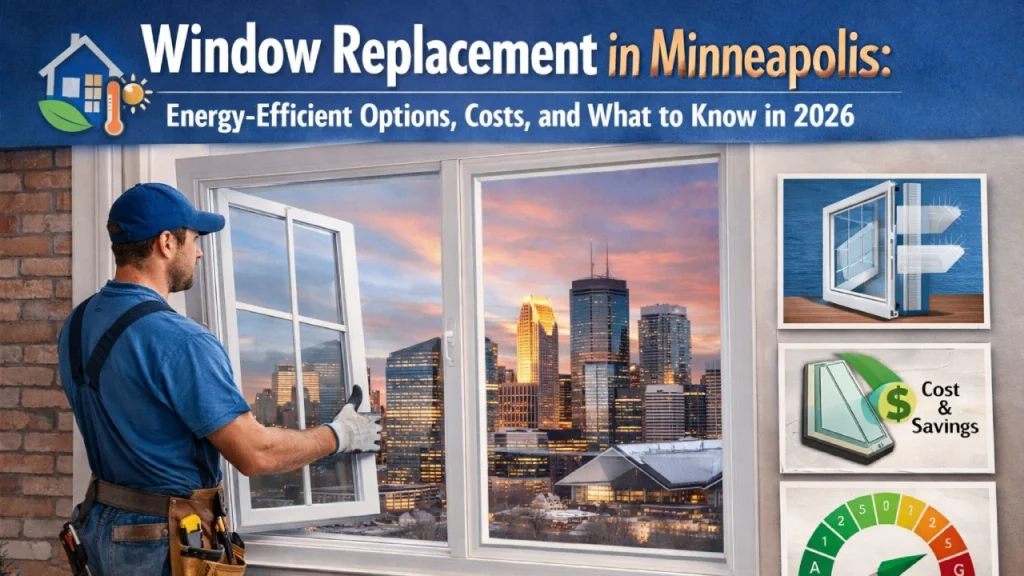
If you've ever pressed your hand against a single-pane window on a January morning in Minneapolis — or watched frost form on the inside of your glass — you already understand the problem. Windows are the weakest link in most home envelopes, and in a climate that swings from -25°F to 95°F over the course of a year, poorly performing windows aren't just uncomfortable. They're expensive, contributing measurably to heating bills that are already among the highest in the country.
Spring is when most Minneapolis homeowners start thinking seriously about window replacement. The heating season is fresh in memory, the drafts and condensation of winter are well-documented, and there's finally enough daylight to inspect windows from outside without layers of snow obscuring the frames. It's also the right time to act — window replacement projects booked in May and June are typically completed before summer heat peaks, and you enter next winter with a meaningfully tighter home.
This guide covers everything you need to know: which window types and glazing options actually perform in a Minnesota climate, what energy-efficient window replacement costs in Minneapolis in 2026, available rebates and tax credits, what the installation process looks like, and how to find a window contractor you can trust.
1. Signs Your Windows Need to Be Replaced
Windows don't fail overnight — they deteriorate gradually, and homeowners often adapt to the symptoms rather than recognizing them as problems. Here are the clearest indicators that repair isn't enough and replacement is the right call:
Drafts You Can Feel Near Closed Windows
Hold your hand near the window frame on a cold, windy day. If you feel air movement with the window fully closed, the weatherstripping has failed, the frame has warped, or the window-to-rough-opening seal has broken down. Minor weatherstripping failure can be repaired; frame warping or seal failure typically cannot be fixed cost-effectively and is a clear replacement indicator.
Condensation Between the Panes of Double or Triple-Pane Windows
Modern insulated glass units (IGUs) are sealed with an inert gas — typically argon or krypton — between the panes. When that seal fails, outside air infiltrates the gap, and condensation or fogging appears between the panes that cannot be wiped away. A failed IGU seal means the window has lost most of its insulating performance. Depending on the window brand and age, you may be able to replace just the glass unit rather than the full window — but many homeowners use seal failure as the right moment to upgrade the entire unit.
Difficulty Opening, Closing, or Locking
Windows that are painted shut, that bind in their tracks, or that won't lock properly are both a comfort and a safety issue. Wood frame windows in older Minneapolis homes swell seasonally, and over many cycles the paint layers and frame distortion accumulate to the point where normal operation isn't possible. Beyond inconvenience, a window that won't lock is a security vulnerability.
Visible Rot, Damage, or Deterioration of the Frame
Wood frame windows that have been inadequately maintained — particularly around the sill and bottom rail where water pools — develop rot that compromises both the seal and the structural integrity of the window. Probe any soft-looking wood with a screwdriver: if it sinks in without resistance, the rot is active and the window needs to go. This is also a warning sign that the surrounding rough opening and trim may have moisture damage requiring repair before the new window is installed.
Noticeably High Heating or Cooling Bills
Single-pane windows have an R-value of approximately 1 — effectively no insulation compared to an insulated wall at R-13 to R-21. Older double-pane windows with failed seals or no low-e coating perform only marginally better. If your windows are original to a home built before 1990, they are likely contributing significantly to your heating bills. The Department of Energy estimates that heat loss through windows accounts for 25–30% of residential heating and cooling energy use nationally — in a Minneapolis climate, that number is weighted heavily toward heating loss.
On a windy day, slowly move a lit candle or incense stick around the perimeter of your window frame — sash, corners, and along the sill. Any flickering or deflection indicates air infiltration. It's a low-tech but reliable way to identify your worst-performing windows before calling a contractor.
2. Window Types and Frame Materials: What Works in Minnesota
Frame material and window style both affect performance, durability, and cost in Minnesota's climate. Here's how the main options compare:
Frame Materials
| Frame Material | MN Climate Performance | Maintenance | Relative Cost | Best For |
|---|---|---|---|---|
| Vinyl (uPVC) | Excellent | Very Low | $ | Most residential replacements |
| Fiberglass | Excellent | Very Low | $$$ | High performance, premium finish |
| Wood-Clad | Good | Low (exterior); Medium (interior) | $$$ | Historic homes, interior wood aesthetic |
| Aluminum | Fair (conducts cold) | Low | $$ | Commercial; not ideal for MN homes |
| Wood (bare) | Fair (moisture-sensitive) | High | $$–$$$ | Historic restoration only |
Vinyl is the dominant choice for residential window replacement in Minneapolis — and for good reason. It doesn't conduct cold the way aluminum does, doesn't rot or require painting like wood, and performs consistently across Minnesota's extreme temperature range. Quality vinyl windows from manufacturers like Andersen, Pella, Marvin, and Renewal by Andersen carry multi-decade warranties and hold their performance well over time.
Fiberglass frames are the premium option — they expand and contract at nearly the same rate as glass, which reduces seal stress over time, and they're dimensionally stable in ways vinyl isn't at the extremes of temperature. The cost premium is significant (30–50% more than comparable vinyl), but for homeowners investing in high-performance triple-pane units, fiberglass frames are worth the conversation.
Window Styles: Which Operate Best in Cold Climates
Beyond frame material, the window style affects both air infiltration and ease of use in cold weather. Double-hung windows (the most common in Minneapolis homes) offer flexibility but have more potential air infiltration points than casement windows, which compress a gasket seal against the frame when closed and are widely considered the tightest-sealing operable window style. Casements also allow full opening for ventilation, which is welcome during Minneapolis's brief but beautiful spring and fall. Fixed (non-operable) windows are the most airtight option of all and make sense in locations where ventilation isn't needed.
3. Glazing and Performance Ratings: What the Numbers Mean
Window performance is measured by two primary ratings you'll see on every energy-efficient window product: U-Factor and Solar Heat Gain Coefficient (SHGC). Understanding what these mean is the key to making the right choice for a Minnesota climate.
U-Factor: The Core Performance Number for Minnesota
U-Factor measures how quickly a window loses heat — lower is better. Single-pane windows typically have a U-Factor around 1.0. A basic double-pane unit runs 0.30–0.50. A quality double-pane with low-e coating and argon fill reaches 0.22–0.28. Triple-pane windows can hit 0.15–0.20. For Minneapolis, the ENERGY STAR program requires a U-Factor of 0.22 or lower for Northern Climate Zone qualification — which covers all of Minnesota. If a window doesn't meet that threshold, it's not genuinely suited for our climate.
SHGC: A Secondary Consideration in Minnesota
Solar Heat Gain Coefficient measures how much solar energy passes through the glass — higher means more solar heat gain. In cooling-dominated climates (the South and Southwest), a low SHGC is desirable to reduce air conditioning load. In Minnesota's heating-dominated climate, the calculus is more nuanced: south-facing windows can meaningfully contribute to passive solar heating in winter with a higher SHGC, while west-facing windows may benefit from lower SHGC to reduce summer afternoon heat gain. Most Minneapolis homeowners default to a moderate SHGC in the 0.25–0.40 range, which balances both concerns without requiring window-by-window optimization.
Double-Pane vs. Triple-Pane: Is the Upgrade Worth It?
Triple-pane windows add a third layer of glass and a second gas-filled cavity, pushing U-Factors below 0.20 and providing noticeably better sound dampening. They're standard in Scandinavian climates similar to Minnesota's and are increasingly available from major manufacturers. The cost premium over double-pane is typically 15–30%. For most Minneapolis homes, a quality double-pane unit with low-e coating and argon fill hits the practical performance ceiling — the additional improvement from triple-pane is real but modest. However, for rooms where comfort is paramount (bedrooms on north or west exposures, rooms with large window areas, or homes in particularly exposed locations), triple-pane is a worthwhile conversation.
Low-E Coatings: Non-Negotiable in Minnesota
Low-emissivity (low-e) coatings are microscopically thin metallic layers applied to glass surfaces that reflect infrared radiation — keeping heat inside in winter and outside in summer. In Minnesota's climate, low-e coating on a double-pane window is not a premium upgrade; it's a baseline requirement. Any window quote for a Minneapolis home that doesn't include low-e glass on double-pane units should be questioned.
Every ENERGY STAR-certified window displays its U-Factor and SHGC. For Minnesota (Northern Climate Zone), look for: U-Factor ≤ 0.22 and ENERGY STAR Northern Climate Zone certification. These qualifications also determine eligibility for the federal Energy Efficient Home Improvement Tax Credit and Xcel Energy rebates.
4. Window Replacement Cost in Minneapolis (2026)
Window replacement costs vary significantly based on window size, style, frame material, glazing package, and whether the installation is a simple insert replacement or a full frame replacement requiring exterior work. Here are realistic ranges for the Minneapolis metro in 2026:
Per-Window Cost Ranges (Installed)
- Standard double-hung vinyl, double-pane with low-e (insert replacement): $400 – $800 per window
- Casement or awning vinyl, double-pane with low-e (insert replacement): $500 – $950 per window
- Fiberglass double-pane, low-e (insert replacement): $700 – $1,400 per window
- Triple-pane vinyl or fiberglass (insert replacement): $800 – $1,600 per window
- Full-frame replacement (any material, requires exterior work): Add $200 – $600 per window
- Large picture windows or specialty shapes: $1,000 – $3,500+ per unit
Whole-Home Replacement Project Costs
- Small home (10–14 windows), standard vinyl: $6,000 – $14,000
- Mid-size home (15–22 windows), quality vinyl with low-e: $12,000 – $24,000
- Larger home (23+ windows), fiberglass or triple-pane: $25,000 – $50,000+
Insert vs. Full-Frame Replacement: What's the Difference?
An insert replacement (also called a pocket replacement) installs a new window unit into the existing frame, leaving the interior and exterior trim intact. It's faster, less disruptive, and less expensive — but it requires that the existing frame be structurally sound, square, and free of rot. If the frame is in good shape, insert replacement is usually the right call.
A full-frame replacement removes everything — the window unit, the frame, and the trim — and installs a new unit into the rough opening. It's necessary when the existing frame is rotted, when you're changing the window size or style, or when you want to address moisture barriers and flashing as part of the project. Full-frame replacement costs more but allows the contractor to verify and correct any moisture damage in the surrounding wall assembly — which can be a meaningful long-term advantage in Minneapolis's wet springs and ice dam-prone winters.
When getting quotes, ask specifically whether the proposed scope is insert or full-frame for each window location. A lower bid may reflect insert replacement where full-frame is actually warranted — a cost difference that matters a lot five years later.
5. Rebates, Tax Credits, and Financing for Window Replacement
Several programs can meaningfully offset the cost of energy-efficient window replacement in Minneapolis. Here's the current landscape:
Federal Energy Efficient Home Improvement Tax Credit (25C)
Under the Inflation Reduction Act, homeowners who install ENERGY STAR-certified windows that meet the Northern Climate Zone U-Factor requirement (≤ 0.22) may claim a federal tax credit of 30% of the product cost (not installation labor), up to $600 per year for windows and skylights. This is a tax credit — not a deduction — which means it reduces your tax bill dollar for dollar. For a $15,000 whole-home window project, the product cost component could generate a credit of several hundred dollars. Consult a tax professional for your specific eligibility, and retain the ENERGY STAR certification documentation for your windows.
Xcel Energy Rebates
Xcel Energy offers rebates through its Home Energy Squad program for qualifying window replacements. Rebate amounts and qualifying criteria change periodically — check the Xcel Energy residential rebates page for current offers. These rebates are typically available on a per-window basis for ENERGY STAR-qualified units and can add up meaningfully on a whole-home project.
Minnesota Housing Finance Agency (MHFA)
The MHFA's Fix-Up Fund provides low-interest financing for home energy improvements, including window replacement, for income-qualifying homeowners. Interest rates are typically below market and terms are flexible. The program is administered through participating lenders across the state — see the Minnesota Housing website for current program details.
Centerpoint Energy Rebates
If your home is heated with natural gas through CenterPoint Energy, additional rebates may be available for qualifying insulation and air sealing improvements that often accompany window replacement projects. It's worth checking whether bundling window replacement with insulation improvements unlocks additional incentive stacking.
To claim the 25C tax credit, you'll need manufacturer documentation showing your windows' ENERGY STAR certification and U-Factor rating. Ask your contractor to provide this at the time of installation — chasing it down later is a headache. File it with your tax records.
6. What the Window Replacement Process Looks Like
Understanding the process helps set realistic expectations and makes it easier to evaluate contractor proposals and timelines.
Step 1: In-Home Assessment
A reputable window contractor will measure each window opening precisely — windows are not standard sizes, and even windows that appear identical in a home often vary by fractions of an inch that matter for fit. They should also assess each existing frame for rot, moisture damage, and structural integrity to determine whether insert or full-frame replacement is appropriate for each location. A contractor who quotes a whole-home project from a photo or a quick walkthrough without measuring is cutting a corner that will show up as a problem at installation.
Step 2: Product Selection and Order
Once scope and measurements are confirmed, windows are custom-ordered from the manufacturer. Lead times for vinyl and fiberglass windows from major brands typically run 3–6 weeks — longer for specialty shapes, colors, or grille patterns. Spring orders placed in May often arrive for June or July installation, which is ideal timing.
Step 3: Installation Day(s)
An experienced crew typically installs 8–12 standard windows per day. For a whole-home project of 15–20 windows, most jobs are completed in 2–3 days. The room being worked on will be exposed to outside air temporarily — in May or June in Minneapolis, this is manageable. Each window installation involves removing the old unit, inspecting and repairing the rough opening as needed, installing the new unit with proper shimming and leveling, insulating the gap around the frame (low-expansion spray foam is standard), and reinstalling interior trim.
Step 4: Exterior Finishing
On full-frame replacements, exterior capping or trim work is installed after the window unit is in place. Flashing is a critical detail here — properly integrated flashing at the head and sill directs water away from the wall assembly. On insert replacements, the existing exterior trim is retained, but caulk joints at the perimeter of the new unit are inspected and renewed.
Step 5: Cleanup and Inspection
All old window units and packaging debris should be removed from the property. Most manufacturers require the homeowner to register the window within a specified period to activate the warranty — your contractor should walk you through this step or handle it on your behalf.
7. How to Choose a Window Contractor in Minneapolis
Window replacement is a competitive category in the Twin Cities, and the range in contractor quality is wide. Here's how to sort through it:
Verify Minnesota Contractor Licensing
Window replacement contractors in Minnesota must hold a Residential Remodeler license through the Minnesota Department of Labor and Industry. Verify the license number before signing anything — it takes 60 seconds online and is a baseline qualifier.
Be Cautious of High-Pressure Sales Tactics
Several national window replacement chains operating in the Minneapolis market are known for high-pressure sales presentations with same-day "expiring offers." These tactics exist to prevent you from getting competing bids. A contractor confident in their product and pricing will give you time to compare. Walk away from any presentation that creates artificial urgency.
Ask Specifically About Installation Crew
Some window companies sell under one brand name but subcontract installation to rotating crews. Ask directly: are the installers your employees or subcontractors? If subcontractors, how do you ensure installation quality and who is responsible if there's a problem? The quality of installation matters as much as the quality of the window — a great window poorly installed will underperform.
Understand What the Warranty Actually Covers
Window warranties have two components: the manufacturer's product warranty (typically covering glass seal failure, hardware, and frame integrity) and the contractor's workmanship warranty (covering installation defects). Make sure you understand both. A lifetime product warranty is only useful if the manufacturer is still in business and the warranty is transferable if you sell the home.
Get Three Itemized Bids
An itemized bid specifies the window brand, product line, frame material, glass package (U-Factor, SHGC, gas fill, low-e type), and whether each window is insert or full-frame replacement. Compare bids at this level of detail — otherwise you may be comparing a triple-pane fiberglass unit in one bid to a basic double-pane vinyl in another, at seemingly similar prices.
Ready to Replace Your Windows in Minneapolis?
Knutson Partners installs energy-efficient replacement windows for Minneapolis–St. Paul homeowners. We measure every opening precisely, recommend the right product for your home and budget, and install with a workmanship warranty. Contact us this spring to get on the schedule before summer.
Get a Free Window Replacement Estimate →8. FAQ: Window Replacement in Minneapolis
How many windows does the average Minneapolis home have?
Most single-family homes in the Twin Cities metro have between 12 and 22 windows, depending on the home's size and style. Two-story colonials and larger craftsman homes tend toward the higher end; ramblers and smaller bungalows toward the lower. An in-home assessment will give you an exact count and flag any windows where full-frame replacement is warranted rather than a standard insert.
How long does window replacement take?
For a typical whole-home project of 15–20 windows, installation takes 2–3 days for an experienced crew. Individual window replacements can often be completed in a single afternoon. Lead time from order to installation is typically 3–6 weeks depending on the manufacturer and product line. Plan for that lead time when scheduling spring projects.
Is it worth replacing windows for energy savings in Minneapolis?
The energy savings math depends on what you're replacing. If you have single-pane original windows in a pre-1980 home, the payback on quality double-pane low-e replacements can be meaningful — particularly when combined with available tax credits and rebates. If you already have functional double-pane windows without failed seals, the incremental energy savings of replacement are more modest, and the payback period is longer. Window replacement is often most justified on the combined merits of comfort improvement, reduced condensation, noise reduction, and home value — not energy savings alone.
What's the difference between insert and full-frame window replacement?
An insert replacement installs the new window unit inside the existing frame, leaving trim intact. It's faster and less expensive but requires a structurally sound existing frame. A full-frame replacement removes the entire existing window and frame down to the rough opening — necessary when there's rot, a size change, or when you want to inspect and repair the moisture barrier and flashing. Your contractor should assess each window location individually rather than applying a one-size approach to the whole home.
Do double-pane windows eliminate frost on the glass in Minneapolis winters?
Quality double-pane windows with low-e coating significantly reduce interior frost and condensation compared to single-pane windows. However, extreme cold events (temperatures below -15°F to -20°F, which Minneapolis does experience) can cause some condensation or light frost on even well-performing double-pane windows at the very edge of the glass near the frame — this is normal and not a sign of seal failure. Triple-pane windows perform better in these extreme conditions, and fiberglass frames (which don't conduct cold the way vinyl can at extremes) are an advantage in particularly cold exposures.
Can Knutson Partners also address wall insulation when replacing windows?
Yes. Window replacement is an excellent time to evaluate and improve the wall insulation and air sealing around window rough openings — and for homes with older wall insulation throughout. Knutson Partners handles insulation installation and upgrades alongside window and exterior work, which allows for better project coordination and may enable utility rebate stacking. Ask about bundling when you contact us for an estimate.
What about commercial window replacement in Minneapolis?
Knutson Partners also handles commercial window replacement for office buildings, multi-tenant properties, and mixed-use buildings across the Twin Cities. Commercial projects involve different product specifications, framing systems, and building code requirements — contact us to discuss your commercial property's needs separately from a residential project.
The Bottom Line on Window Replacement in Minneapolis
The case for replacing old windows in a Minneapolis home is rarely just about energy savings — it's about comfort, moisture control, sound, security, and the cumulative effect of a tighter, better-performing home envelope. The right time to act is spring: you can identify your worst-performing windows while their winter performance is still fresh in memory, order custom units with a lead time that puts installation in June or July, and have a meaningfully better home before next winter arrives.
Start with an honest in-home assessment from a contractor who will measure accurately, recommend the right product for each location, and give you a clear, itemized proposal. Do that with three contractors, verify licensing, and you'll make a decision you're confident in.
Knutson Partners installs energy-efficient replacement windows for Minneapolis–St. Paul homeowners. We handle residential and commercial window replacement, alongside siding, roofing, insulation, and exterior work. Contact us today for a free, no-pressure estimate.